
FT232RL-REEL
IC USB FS SERIAL UART 28-SSOP
The FT232R is the latest device to be added to FTDI’s range of USB UART interface Integrated Circuit Devices. The FT232R is a USB to serial UART interface with optional clock generator output, and the new FTDIChip-ID™ security dongle feature. In addition, asynchronous and synchronous bit bang interface modes are available. USB to serial designs using the FT232R have been further simplified by fully integrating the external EEPROM, clock circuit and USB resistors onto the device.
The FT232R adds two new functions compared with its predecessors, effectively making it a “3-in-1” chip for some application areas. The internally generated clock (6MHz, 12MHz, 24MHz, and 48MHz) can be brought out of the device and used to drive a microcontroller or external logic. A unique number (the FTDIChip-ID™) is burnt into the device during manufacture and is readable over USB, thus forming the basis of a security dongle which can be used to protect customer application software from being copied.
The FT232R is available in Pb-free (RoHS compliant) compact 28-Lead SSOP and QFN-32 packages.
Features
1.1 Hardware Features
• Single chip USB to asynchronous serial data transfer interface.
• Entire USB protocol handled on the chip - No USB-specific firmware programming required.
• UART interface support for 7 or 8 data bits, 1 or 2 stop bits and odd / even / mark / space / no parity.
• Fully assisted hardware or X-On / X-Off software handshaking.
• Data transfer rates from 300 baud to 3 Megabaud (RS422 / RS485 and at TTL levels) and 300 baud to 1 Megabaud (RS232).
• 256 byte receive buffer and 128 byte transmit buffer utilising buffer smoothing technology to allow for high data throughput.
• FTDI’s royalty-free VCP and D2XX drivers eliminate the requirement for USB driver development in most cases.
• In-built support for event characters and line break condition.
• New USB FTDIChip-ID™ feature.
• New configurable CBUS I/O pins.
• Auto transmit buffer control for RS485 applications.
• Transmit and receive LED drive signals.
• New 48MHz, 24MHz,12MHz, and 6MHz clock output signal Options for driving external MCU or FPGA.
• FIFO receive and transmit buffers for high data throughput.
• Adjustable receive buffer timeout.
• Synchronous and asynchronous bit bang mode interface options with RD# and WR# strobes.
• New CBUS bit bang mode option.
• Integrated 1024 Bit internal EEPROM for storing USB VID, PID, serial number and product description strings, and CBUS I/O configuration.
• Device supplied preprogrammed with unique USB serial number.
• Support for USB suspend and resume.
• Support for bus powered, self powered, and high power bus powered USB configurations.
• Integrated 3.3V level converter for USB I/O .
• Integrated level converter on UART and CBUS for interfacing to 5V - 1.8V Logic.
• True 5V / 3.3V / 2.8V / 1.8V CMOS drive output and TTL input.
• High I/O pin output drive option.
• Integrated USB resistors.
• Integrated power-on-reset circuit.
• Fully integrated clock - no external crystal, oscillator, or resonator required.
• Fully integrated AVCC supply filtering - No separate AVCC pin and no external R-C filter required.
• UART signal inversion option.
• USB bulk transfer mode.
• 3.3V to 5.25V Single Supply Operation.
• Low operating and USB suspend current.
• Low USB bandwidth consumption.
• UHCI / OHCI / EHCI host controller compatible
• USB 2.0 Full Speed compatible.
• -40°C to 85°C extended operating temperature range.
• Available in compact Pb-free 28 Pin SSOP and QFN-32 packages (both RoHS compliant).
1.2 Driver Support
• Windows 98, 98SE, ME, 2000, Server 2003, XP.
• Windows Vista / Longhorn*
• Windows XP 64-bit.*
• Windows XP Embedded.
• Windows CE.NET 4.2 & 5.0
• MAC OS 8 / 9, OS-X
• Linux 2.4 and greater
• Windows 98, 98SE, ME, 2000, Server 2003, XP.
• Windows Vista / Longhorn*
• Windows XP 64-bit.*
• Windows XP Embedded.
• Windows CE.NET 4.2 & 5.0
• Linux 2.4 and greater
1.3 Typical Applications
• USB to RS232 / RS422 / RS485 Converters
• Upgrading Legacy Peripherals to USB
• Cellular and Cordless Phone USB data transfer cables and interfaces
• Interfacing MCU / PLD / FPGA based designs to USB
• USB Audio and Low Bandwidth Video data transfer
• PDA to USB data transfer
• USB Smart Card Readers
• USB Instrumentation
• USB Industrial Control
• USB MP3 Player Interface
• USB FLASH Card Reader / Writers
• Set Top Box PC - USB interface
• USB Digital Camera Interface
• USB Hardware Modems
• USB Wireless Modems
• USB Bar Code Readers
• USB Software / Hardware Encryption Dongles
2. Enhancements
2.1 Device Enhancements and Key Features
This section summarises the enhancements and the key features of the FT232R device. For further details, consult the device pin-out description and functional description sections.
Integrated Clock Circuit - Previous generations of FTDI’s USB UART devices required an external crystal or ceramic resonator. The clock circuit has now been integrated onto the device meaning that no crystal or ceramic resonator is required. However, if required, an external 12MHz crystal can be used as the clock source.
Integrated EEPROM - Previous generations of FTDI’s USB UART devices required an external EEPROM if the device were to use USB Vendor ID (VID), Product ID (PID), serial number and product description strings other than the default values in the device itself. This external EEPROM has now been integrated onto the FT232R chip meaning that all designs have the option to change the product description strings. A user area of the internal EEPROM is available for storing additional data. The internal EEPROM is programmable in circuit, over USB without any additional voltage requirement.
Preprogrammed EEPROM - The FT232R is supplied with its internal EEPROM preprogrammed with a serial number which is unique to each individual device. This, in most cases, will remove the need to program the device EEPROM.
Integrated USB Resistors - Previous generations of FTDI’s USB UART devices required two external series resistors on the USBDP and USBDM lines, and a 1.5 kΩ pull up resistor on USBDP. These three resistors have now been integrated onto the device.
Integrated AVCC Filtering - Previous generations of FTDI’s USB UART devices had a separate AVCC pin - the supply to the internal PLL. This pin required an external R-C filter. The separate AVCC pin is now connected internally to VCC, and the filter has now been integrated onto the chip.
Less External Components - Integration of the crystal, EEPROM, USB resistors, and AVCC filter will substantially reduce the bill of materials cost for USB interface designs using the FT232R compared to its FT232BM predecessor.
Transmit and Receive Buffer Smoothing - The FT232R’s 256 byte receive buffer and 128 byte transmit buffer utilise new buffer smoothing technology to allow for high data throughput.
Configurable CBUS I/O Pin Options - There are now 5 configurable Control Bus (CBUS) lines. Options are TXDEN - transmit enable for RS485 designs, PWREN# - Power control for high power, bus powered designs, TXLED# - for pulsing an LED upon transmission of data, RXLED# - for pulsing an LED upon receiving data, TX&RXLED# - which will pulse an LED upon transmission OR reception of data, SLEEP# - indicates that the device going into USB suspend mode, CLK48 / CLK24 / CLK12 / CLK6 - 48MHz, 24MHz,12MHz, and 6MHz clock output signal options. There is also the option to bring out bit bang mode read and write strobes (see below). The CBUS lines can be configured with any one of these output options by setting bits in the internal EEPROM. The device is supplied with the most commonly used pin definitions preprogrammed - see Section 10 for details.
Enhanced Asynchronous Bit Bang Mode with RD# and WR# Strobes - The FT232R supports FTDI’s BM chip bit bang mode. In bit bang mode, the eight UART lines can be switched from the regular interface mode to an 8-bit general purpose I/O port. Data packets can be sent to the device and they will be sequentially sent to the interface at a rate controlled by an internal timer (equivalent to the baud rate prescaler). With the FT232R device this mode has been enhanced so that the internal RD# and WR# strobes are now brought out of the device which can be used to allow external logic to be clocked by accesses to the bit bang I/O bus. This option will be described more fully in a separate application note.
Synchronous Bit Bang Mode - Synchronous bit bang mode differs from asynchronous bit bang mode in that the interface pins are only read when the device is written to. Thus making it easier for the controlling program to measure the response to an output stimulus as the data returned is synchronous to the output data. The feature was previously seen in FTDI’s FT2232C device. This option will be described more fully in a separate application note.
CBUS Bit Bang Mode - This mode allows four of the CBUS pins to be individually configured as GPIO pins, similar to Asynchronous bit bang mode. It is possible to use this mode while the UART interface is being used, thus providing up to four general purpose I/O pins which are available during normal operation. An application note describing this feature is available separately from the FTDI website.
Lower Supply Voltage - Previous generations of the chip required 5V supply on the VCC pin. The FT232R will work with a Vcc supply in the range 3.3V - 5.25V. Bus powered designs would still take their supply from the 5V on the USB bus, but for self powered designs where only 3.3V is available and there is no 5V supply there is no longer any need for an additional external regulator.
Integrated Level Converter on UART Interface and Control Signals - VCCIO pin supply can be from 1.8V to 5V. Connecting the VCCIO pin to 1.8V, 2.8V, or 3.3V allows the device to directly interface to 1.8V, 2.8V or 3.3V and other logic families without the need for external level converter I.C. devices.
5V / 3.3V / 2.8V / 1.8V Logic Interface - The FT232R provides true CMOS Drive Outputs and TTL level Inputs.
Integrated Power-On-Reset (POR) Circuit- The device incorporates an internal POR function. A RESET# pin is available in order to allow external logic to reset the FT232R where required. However, for many applications the RESET# pin can be left unconnected, or pulled up to VCCIO.
Lower Operating and Suspend Current - The device operating supply current has been further reduced to 15mA, and the suspend current has been reduced to around 70μA. This allows greater margin for peripheral designs to meet the USB suspend current limit of 500μA.
Low USB Bandwidth Consumption - The operation of the USB interface to the FT232R has been designed to use as little as possible of the total USB bandwidth available from the USB host controller.
High Output Drive Option - The UART interface and CBUS I/O pins can be made to drive out at three times the standard signal drive level thus allowing multiple devices to be driven, or devices that require a greater signal drive strength to be interfaced to the FT232R. This option is enabled in the internal EEPROM.
Power Management Control for USB Bus Powered, High Current Designs- The PWREN# signal can be used to directly drive a transistor or P-Channel MOSFET in applications where power switching of external circuitry is required. An option in the internal EEPROM makes the device gently pull down on its UART interface lines when the power is shut off (PWREN# is high). In this mode any residual voltage on external circuitry is bled to GND when power is removed, thus ensuring that external circuitry controlled by PWREN# resets reliably when power is restored.
UART Pin Signal Inversion - The sense of each of the eight UART signals can be individually inverted by setting options in the internal EEPROM. Thus, CTS# (active low) can be changed to CTS (active high), or TXD can be changed to TXD#.
FTDIChip-ID™ - Each FT232R is assigned a unique number which is burnt into the device at manufacture. This ID number cannot be reprogrammed by product manufacturers or end-users. This allows the possibility of using FT232R based dongles for software licensing. Further to this, a renewable license scheme can be implemented based on the FTDIChip-ID™ number when encrypted with other information. This encrypted number can be stored in the user area of the FT232R internal EEPROM, and can be decrypted, then compared with the protected FTDIChip-ID™ to verify that a license is valid. Web based applications can be used to maintain product licensing this way. An application note describing this feature is available separately from the FTDI website.
Improved EMI Performance - The reduced operating current and improved on-chip VCC decoupling significantly improves the ease of PCB design requirements in order to meet FCC, CE and other EMI related specifications.
Programmable Receive Buffer Timeout - The receive buffer timeout is used to flush remaining data from the receive buffer. This time defaults to 16ms, but is programmable over USB in 1ms increments from 1ms to 255ms, thus allowing the device to be optimised for protocols that require fast response times from short data packets.
Extended Operating Temperature Range - The FT232R operates over an extended temperature range of -40º to +85º C thus allowing the device to be used in automotive and industrial applications.
New Package Options - The FT232R is available in two packages - a compact 28 pin SSOP ( FT232RL) and an ultra-compact 5mm x 5mm pinless QFN-32 package ( FT232RQ). Both packages are lead ( Pb ) free, and use a ‘green’ compound. Both packages are fully compliant with European Union directive 2002/95/EC.
3. Block Diagram
3.1 Block Diagram (Simplified)
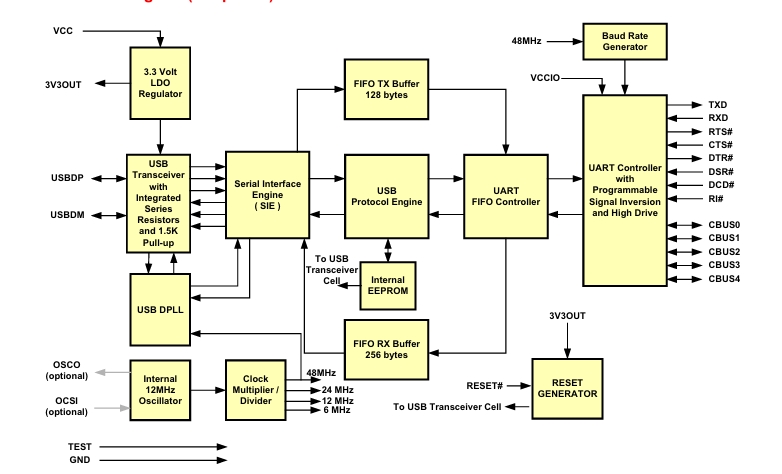
3.2 Functional Block Descriptions
3.3V LDO Regulator - The 3.3V LDO Regulator generates the 3.3V reference voltage for driving the USB transceiver cell output buffers. It requires an external decoupling capacitor to be attached to the 3V3OUT regulator output pin. It also provides 3.3V power to the 1.5kΩ internal pull up resistor on USBDP. The main function of this block is to power the USB Transceiver and the Reset Generator Cells rather than to power external logic. However, external circuitry requiring a 3.3V nominal supply at a current of around than 50mA could also draw its power from the 3V3OUT pin, if required.
USB Transceiver - The USB Transceiver Cell provides the USB 1.1 / USB 2.0 full-speed physical interface to the USB cable. The output drivers provide 3.3V level slew rate control signalling, whilst a differential receiver and two single ended receivers provide USB data in, SEO and USB Reset condition detection. This Cell also incorporates internal USB series resistors on the USB data lines, and a 1.5kΩ pull up resistor on USBDP
USB DPLL - The USB DPLL cell locks on to the incoming NRZI USB data and provides separate recovered clock and data signals to the SIE block.
Internal 12MHz Oscillator - The Internal 12MHz Oscillator cell generates a 12MHz reference clock input to the x4 Clock multiplier. The 12MHz Oscillator is also used as the reference clock for the SIE, USB Protocol Engine and UART FIFO controller blocks
Clock Multiplier / Divider - The Clock Multiplier / Divider takes the 12MHz input from the Oscillator Cell and generates the 48MHz, 24MHz, 12MHz, and 6MHz reference clock signals. The 48Mz clock reference is used for the USB DPLL and the Baud Rate Generator blocks.
Serial Interface Engine (SIE) - The Serial Interface Engine (SIE) block performs the Parallel to Serial and Serial to Parallel conversion of the USB data. In accordance to the USB 2.0 specification, it performs bit stuffing / un-stuffing and CRC5 / CRC16 generation / checking on the USB data stream.
USB Protocol Engine - The USB Protocol Engine manages the data stream from the device USB control endpoint. It handles the low level USB protocol (Chapter 9) requests generated by the USB host controller and the commands for controlling the functional parameters of the UART
FIFO TX Buffer (128 bytes) - Data from the USB data out endpoint is stored in the FIFO TX buffer and removed from the buffer to the UART transmit register under control of the UART FIFO controller.
FIFO RX Buffer (256 bytes) - Data from the UART receive register is stored in the FIFO RX buffer prior to being removed by the SIE on a USB request for data from the device data in endpoint.
UART FIFO Controller - The UART FIFO controller handles the transfer of data between the FIFO RX and TX buffers and the UART transmit and receive registers.
UART Controller with Programmable Signal Inversion and High Drive - Together with the UART FIFO Controller the UART Controller handles the transfer of data between the FIFO RX and FIFO TX buffers and the UART transmit and receive registers. It performs asynchronous 7 / 8 bit Parallel to Serial and Serial to Parallel conversion of the data on the RS232 (RS422 and RS485) interface. Control signals supported by UART mode include RTS, CTS, DSR , DTR, DCD and RI. The UART Controller also provides a transmitter enable control signal pin option (TXDEN) to assist with interfacing to RS485 transceivers. RTS / CTS, DSR / DTR and X-On / X-Off handshaking options are also supported. Handshaking, where required, is handled in hardware to ensure fast response times. The UART also supports the RS232 BREAK setting and detection conditions. A new feature, programmable in the internal EEPROM allows the UART signals to each be individually inverted. Another new EEPROM programmable feature allows a high signal drive strength to be enabled on the UART interface and CBUS pins.
Baud Rate Generator - The Baud Rate Generator provides a x16 clock input to the UART Controller from the 48MHz reference clock and consists of a 14 bit prescaler and 3 register bits which provide fine tuning of the baud rate (used to divide by a number plus a fraction or “sub-integer”). This determines the Baud Rate of the UART, which is programmable from 183 baud to 3 million baud.
The FT232R supports all standard baud rates and non-standard baud rates from 300 Baud up to 3 Megabaud. Achievable non-standard baud rates are calculated as follows
Baud Rate = 3000000 / (n + x)
where n can be any integer between 2 and 16,384 ( = 214 ) and x can be a sub-integer of the value 0, 0.125, 0.25, 0.375, 0.5, 0.625, 0.75, or 0.875. When n = 1, x = 0, i.e. baud rate divisors with values between 1 and 2 are not possible.
This gives achievable baud rates in the range 183.1 baud to 3,000,000 baud. When a non-standard baud rate is required simply pass the required baud rate value to the driver as normal, and the FTDI driver will calculate the required divisor, and set the baud rate. See FTDI application note AN232B-05 for more details.
RESET Generator - The integrated Reset Generator Cell provides a reliable power-on reset to the device internal circuitry on power up. A RESET# input pin is provided to allow other devices to reset the FT232R. RESET# can be tied to VCCIO or left unconnected, unless it is a requirement to reset the device from external logic or an external reset generator I.C.
Internal EEPROM - The internal EEPROM in the FT232R can be used to store USB Vendor ID (VID), Product ID (PID), device serial number, product description string, and various other USB configuration descriptors. The internal EEPROM is also used to configure the CBUS pin functions. The device is supplied with the internal EEPROM settings preprogrammed as described in Section 10
- LP8557IEVM_TI(德州仪器)中文资料_英文资料_价格_PDF手册
- LAUNCHXL-F28027F TI(德州仪器)中文资料_英文资料_价格_PDF手册
- DLPDLCR160CPEVM DLP160CP TI(德州仪器)中文资料_英文资料_价格_PDF手册
- THS4631DDAEVM TI(德州仪器)中文资料_英文资料_价格_PDF手册
- DAC3482EVM TI(德州仪器)中文资料_英文资料_价格_PDF手册
- THS4302EVM TI(德州仪器)中文资料_英文资料_价格_PDF手册
- ADS7038Q1EVM-PDK_TI(德州仪器)中文资料_英文资料_价格_PDF手册
- LM3450AEV230V30/NOPB_TI(德州仪器)中文资料_英文资料_价格_PDF手册
- TPS72728DSEEVM-406_TI(德州仪器)中文资料_英文资料_价格_PDF手册
- WL1835MODCOM8A_TI(德州仪器)中文资料_英文资料_价格_PDF手册
- TAS5424BQ1DKDEVM_TI(德州仪器)中文资料_英文资料_价格_PDF手册
- ADS7042EVM-PDK_TI(德州仪器)中文资料_英文资料_价格_PDF手册
- TMDS570LS31HDK_TI(德州仪器)中文资料_英文资料_价格_PDF手册
- VCA8500BOARD_TI(德州仪器)中文资料_英文资料_价格_PDF手册
- DEM-SOT223LDO_TI(德州仪器)中文资料_英文资料_价格_PDF手册
 工商网监
工商网监