
This is the jumper used to enable the LED driver (HWEN pin). The driver will be enabled when the HWEN pin is high (VIO) and disabled when it is low (GND).LM3632EVM
1 Introduction
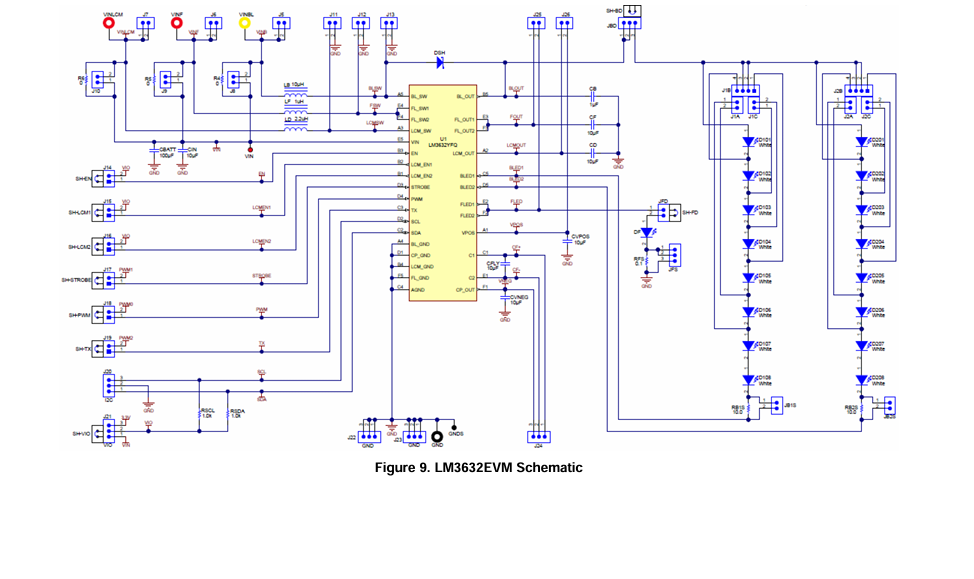
The Texas Instruments LM3632EVM evaluation module (EVM) helps designers evaluate the operation and performance of the LM3632A Backlight + Bias Power + Flash Driver. The device offers configurability via I2C-compatible interface. All three blocks can be enabled via the I2C interface. In addition, the Flash Driver and LCM Bias can be enabled externally using the STROBE and LCM_EN pins. The module utilizes two strings of 8 backlight LEDs connected in series and a flash LED mounted on the EVM. The EVM contains one LM3632A device (see Table 1).
2 Setup
This section describes the jumpers and connectors on the EVM as well as how to properly connect, set up and use the LM3632EVM.
2.1 Input/Output Connector Description
2.1.1 Input / GND
There are three input terminals and one ground for the EVM, providing a power (VIN) and ground (GND) connection to allow the user to attach the EVM to a cable harness. The three input terminals allow the user to split the input to the three boost drivers so that the input power to each block can be measured independently. All three input terminals can be shorted together by jumpers J8, J9, and J10 or by 0-Ω resistors R4, R5, and R6 (not assembled).
2.1.2 EN (J14)
This is the jumper used to enable the LED driver (HWEN pin). The driver will be enabled when the HWEN pin is high (VIO) and disabled when it is low (GND).
2.1.3 VIO (J21)
This pin provides power for the I2C lines (Clock and Data) and for the HWEN pin. It is recommended that this pin is connected to the VIN pin. If desired, it can be connected to the 3.3-V line provided by the USB interface connector. In this configuration, communication via the I2C interface may not be possible if the supply voltage to the LED driver is below approximately 3 V.
2.1.4 LCM1EN (J15) & LCM2EN (J16)
These jumpers can be used to externally enable the VPOS and VNEG outputs of the LCM Bias block. The outputs will be enabled when the pins are high (VIO) and disabled when left floating. There are 300-kΩ pull-down resistors to GND on both of these pins. The LCMEN1 & LCMEN2 pins can also be controlled externally by applying a signal directly to the pins.
2.1.5 Backlight LED Connector (JBD)
This jumper connects the backlight LED strings to the outputs of the backlight boost output pin, BL_OUT. Place jumper between BLOUT & DBL pins.
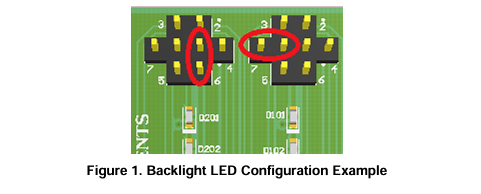
2.1.6 Backlight LED Configuration Connectors
The user can use these connectors to configure each string’s number of LEDs. The default configuration is 8 LEDs in series (no jumpers). To achieve a configuration of 2 LEDs in series place a jumper on location “2”, 3 LEDs on location “3” and so on. For example, placing the jumpers as shown on Figure 1, will configure string 2 with 6 LEDs and string 1 with 7 LEDs.
2.1.7 JFD Jumper
The JFD is used to connect the on-board flash LED to the LED output of the flash driver.
2.1.8 PWM(J18)
This pin is the PWM input signal for backlight LED current adjustment. It can be driven externally or if connected to pin PWM0 via a jumper it can be driven by a using the General User Interface (GUI) software provided.
2.1.9 STROBE (J17)
This pin provides an external method for initiating a flash event. The STROBE pin is connected to ground via a 300-kΩ resistor internal to the LM3632. To externally drive this pin, either connect a control signal directly to the STROBE pin of the connector or place a jumper between connector pins STROBE and PWM1. The PWM1 pin can be configured as ON, OFF, time-adjustable voltage pulse or continuous voltage pulses of adjustable frequency and duty cycle via the GUI software provided.
2.1.10 TX (J19)
This pin is used to initiate a TX-interrupt event. The TX pin is connected to ground via a 300-kΩ resistor internal to the LM3632. To externally drive this pin, either connect a control signal directly to the TX pin of the connector or place a jumper between connector pins TX and PWM2. The PWM2 pin can be configured as ON, OFF, time-adjustable voltage pulse, or continuous voltage pulses of adjustable frequency and duty cycle via the GUI software provided.
2.1.11 SDA / SCL (J20)
These connections allow the user to externally control the I2C lines. For independent control of the I2C lines, do not connect the VIO jumper to either the 3.3 V or the VIN pin.
2.1.12 FOUT, FLED (J25)
These provide access to the regulated outputs of the flash driver and the flash LED current source. The user can measure VOUT with reference to GND, VLED with reference to GND and current source headroom directly between VOUT and VLED .
2.1.13 LCMOUT, VPOS (J26)
These provide access to the regulated output of the LCM bias boost and the VPOS output. The user can measure LCMOUT and VPOS with reference to GND.
2.1.14 VNEG, CF-, CF+ (J24
These provide access to the regulated inverting charge pump output (VNEG) and to the charge pump positive and negative flying cap connections. The user can measure VNEG with reference to GND and can monitor the voltage waveforms at the flying cap terminals.
2.1.15 BLSW (J13), FSW (J12), LCMSW (J11)
These connectors can be used to monitor the voltage waveforms at the switch pin of each boost circuit.
VINBL/VIN (J8), VINLCM/VIN (J10), VINF/VIN (J9)
The user can monitor the inductor current and input current waveforms for each of the three boost blocks by omitting these jumpers and using separate wires from the power supply to the inductors and VIN. This will remove the input capacitors from the inductors and eliminate their filtering effect to the inductor current.
2.1.16 JFS– Flash LED Current Measurement
The LM3632EVM provides a way to accurately measure the LED current through the LED on board. Resistor RFS (0.1 Ω) is placed between the cathode of flash LED (DF) and Ground. The user can first measure the resistor value accurately, by applying a known current through connector DFHF and ground and measuring the voltage between DFHS and DFLS. Then, during normal flash or torch operation, the voltage measured across the resistor divided by the resistor value will equal the current through the resistor (and the LED).
2.1.17 JB1S & JB2S– Backlight String Current Measurements
The LM3632EVM provides a way to accurately measure the current through the backlight LED strings on board. Resistors RB1S & RB2S (10 Ω) are placed between the LED strings and the current sink inputs of the LM3632. The user can measure the voltage across the resistor(s) and calculate the current(s) through the resistor(s) by dividing the voltage by 10 Ω.
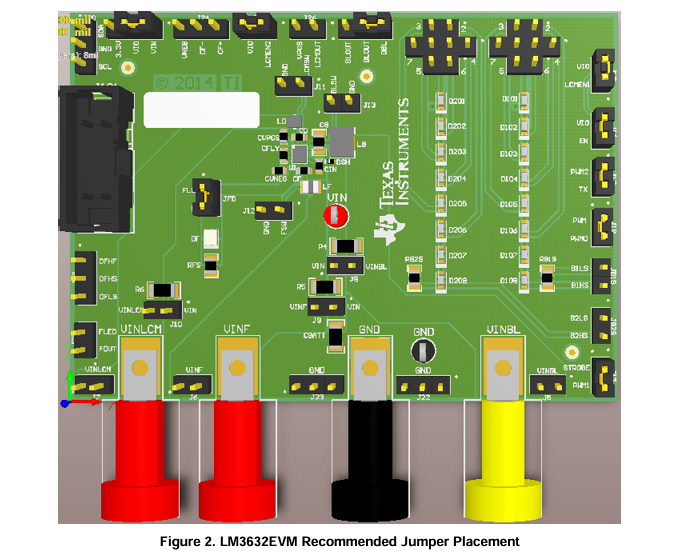
2.2 Setup
The input voltage range for the LM3632A is 2.7 V to 5 V. The on-board backlight and flash LEDs should
be connected, and the jumpers should be properly configured for proper operation. This is the
recommended setting, using shorting blocks:
• VIOto VIN (J21), Except for silicon A0
• ENtoVIO(J14)
• Flash LED (JFD) shorted
• Backlight LEDs (JBD) shorted
• J8shorted or R4 = 0 Ω
• J9shorted or R5 = 0 Ω
• J10shorted or R6 = 0 Ω
• PWMtoPWM0(J18) or external signal
• STROBEto PWM1(J17) or external signal
• TXtoPWM2(J19) or external signal
In this configuration, the device will power up when power is applied and all outputs can be enabled. Refer
to Figure 2 for recommended jumper placement.
3
Board Layout
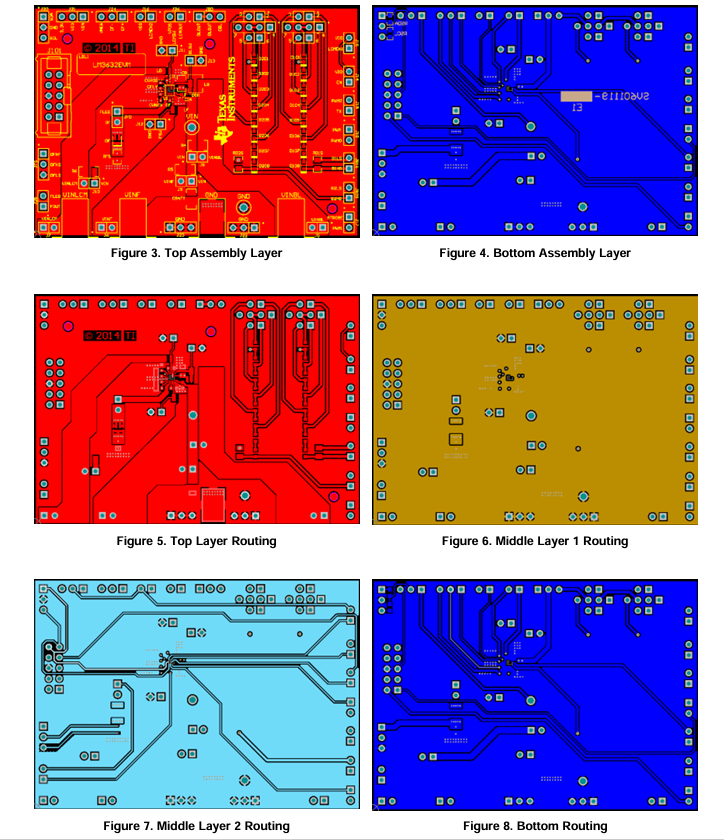
Figure 3, Figure 4, Figure 5, Figure 6, Figure 7 and Figure 8 show the board layout for the LM3632EVM. The EVM offers resistors, capacitors, and jumpers to enable the device and to configure it as desired. The LM3632A will dissipate power, especially during high currents and long duration flash events. Power will also be dissipated on the flash and backlight LEDs. The EVM layout is designed to minimize temperature rise during operation. It is recommended that in order to prevent overheating, repeated flash events in very short time intervals is avoided.
4
Schematic
- 苏州杭晶电子入驻工之芯商城,成为优质供应商
- TPS7A30-49EVM-567_TI(德州仪器)中文资料_英文资料_价格_PDF手册
- TLA2024EVM-PDK_TI(德州仪器)中文资料_英文资料_价格_PDF手册
- INA229_239EVM_TI(德州仪器)中文资料_英文资料_价格_PDF手册
- DAC8832EVM-PDK _TI(德州仪器)中文资料_英文资料_价格_PDF手册
- LP8557IEVM_TI(德州仪器)中文资料_英文资料_价格_PDF手册
- LAUNCHXL-F28027F TI(德州仪器)中文资料_英文资料_价格_PDF手册
- DLPDLCR160CPEVM DLP160CP TI(德州仪器)中文资料_英文资料_价格_PDF手册
- THS4631DDAEVM TI(德州仪器)中文资料_英文资料_价格_PDF手册
- DAC3482EVM TI(德州仪器)中文资料_英文资料_价格_PDF手册
- THS4302EVM TI(德州仪器)中文资料_英文资料_价格_PDF手册
- ADS7038Q1EVM-PDK_TI(德州仪器)中文资料_英文资料_价格_PDF手册
- LM3450AEV230V30/NOPB_TI(德州仪器)中文资料_英文资料_价格_PDF手册
- TPS72728DSEEVM-406_TI(德州仪器)中文资料_英文资料_价格_PDF手册
- WL1835MODCOM8A_TI(德州仪器)中文资料_英文资料_价格_PDF手册
 工商网监
工商网监